
For most of human history, we believed our solar system was an isolated bubble drifting through the galaxy, untouched by outsiders or was it?
In the last few years, astronomers have spotted something extraordinary: 3 mysterious visitors from another star systems passing right through our cosmic neighbourhood. These weren’t asteroids or ordinary comets; they were true interstellar travellers, carrying secrets from distant worlds billions of kilometres away.
ʻOumuamua, Borisov, and Atlas stunned scientists and shook the foundations of modern astronomy. Each came from beyond our Sun’s reach, each behaved unlike anything we’d ever seen before, and each forced us to rethink what we know about the universe.
Today, we’ll explore how these cosmic messengers from beyond the stars rewrote the rules of space science, and we’ll also know why their arrival may be just the beginning of a new era in interstellar discovery.
Oumuamua: The First Visitor from Beyond
In October 2017, astronomers at the University of Hawaii’s Pan-STARRS1 telescope spotted a faint, fast-moving object hurtling through the inner solar system. Initially classified as a comet, then an asteroid, it was soon determined to be something entirely different.
This was “Oumuamua”, a Hawaiian word which means “a messenger from afar arriving first.” It was the first known interstellar object ever detected passing through our solar system.
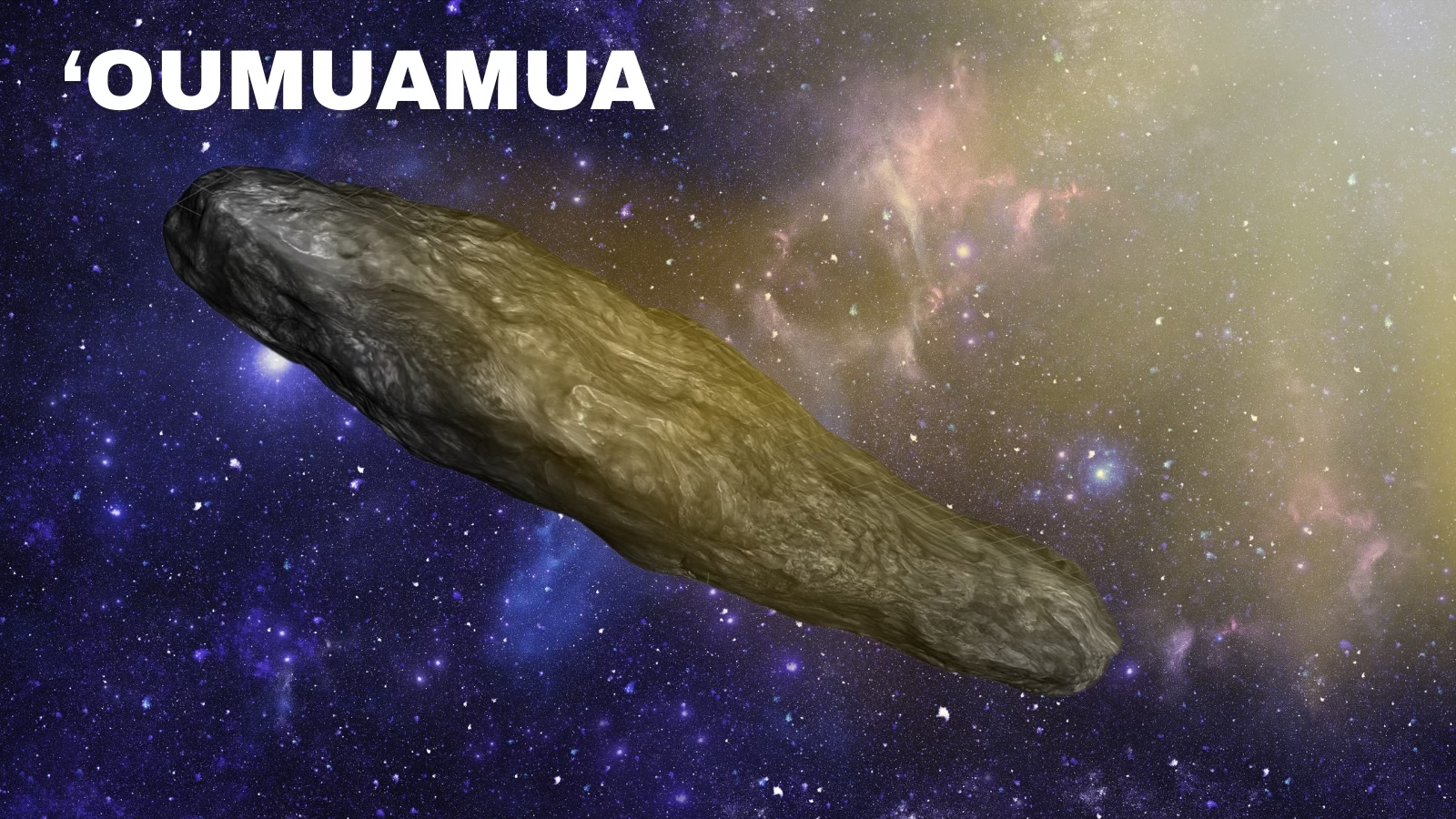
Unusual Traits and Mysterious Origins
ʻOumuamua’s characteristics baffled scientists. It was highly elongated, possibly cigar or pancake shaped, measuring about 400 meters in length. It had no visible coma or tail, which are typical for comets and yet it exhibited a slight acceleration as it moved away from the Sun, which was something that couldn’t be fully explained by gravity alone.
Its trajectory was hyperbolic, meaning it was not bound by the Sun’s gravity as it came from another star system and would never return.
Theories and Controversies
Theories about ʻOumuamua’s origin are endless. Some scientists proposed it was a fragment of a larger planetesimal ejected from another star system. Others suggested it might be made of hydrogen or nitrogen ice, allowing sublimation to cause its peculiar acceleration without producing a visible tail.
However, one of the most debated ideas came from Harvard astronomer Avi Loeb, who proposed that ʻOumuamua could be an artificial object, perhaps a fragment of alien technology or a light sail. While this remains unproven and controversial, it opened a broader scientific dialogue about how we interpret anomalous phenomena in astronomy.
Regardless of its true nature, ʻOumuamua was a cosmic first, a tangible connection to another star system that set the stage for future interstellar discoveries.
Borisov: The True Interstellar Comet
Just two years after ʻOumuamua’s discovery, in August 2019, amateur astronomer Gennadiy Borisov from Crimea spotted another unusual object through his homemade telescope. It was named 2I/Borisov and became the second confirmed interstellar object, and the first unmistakably cometary one to enter our solar system.
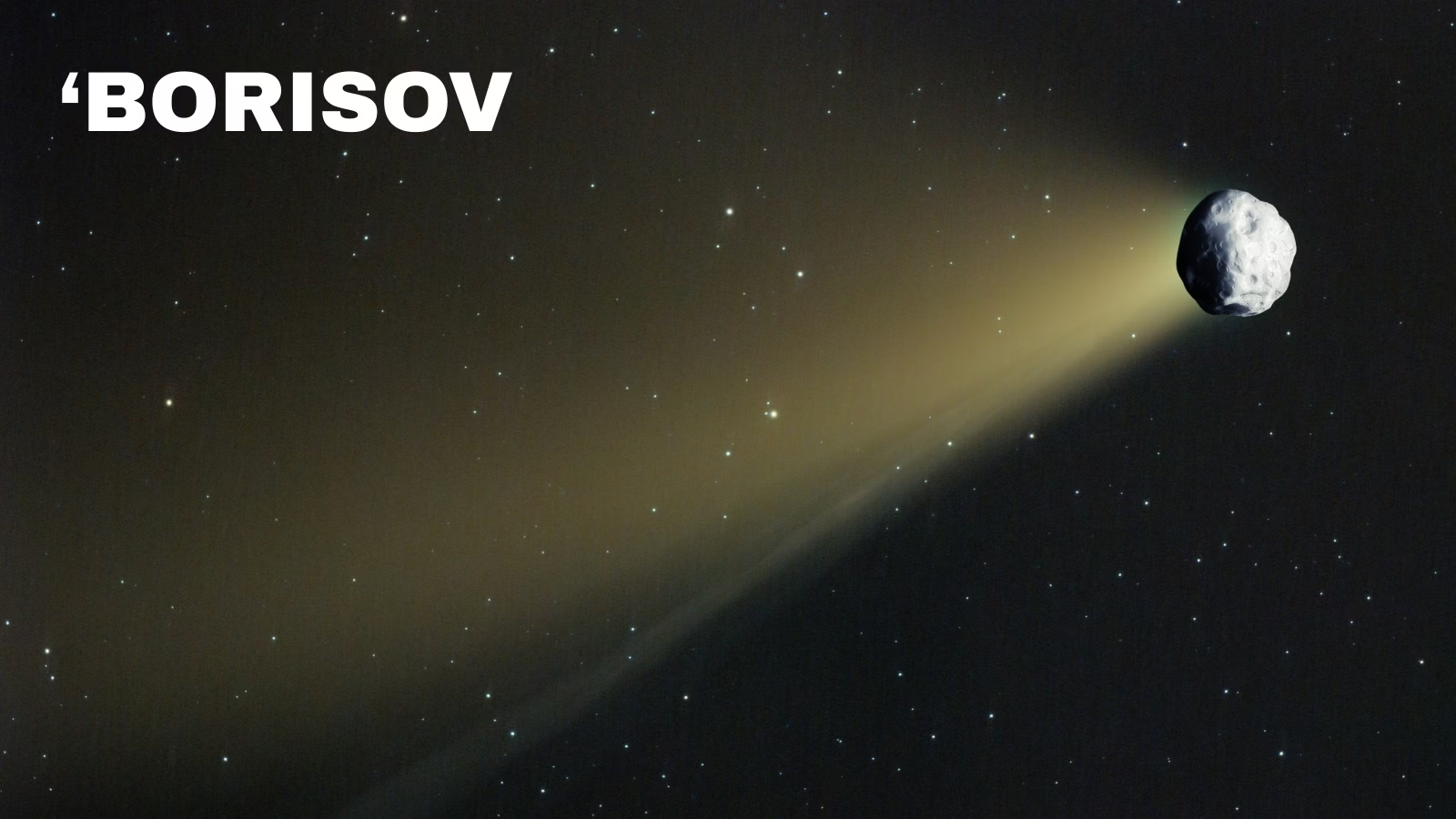
A Comet from Another Star
Unlike ʻOumuamua, Borisov looked and behaved like a typical comet, sporting a bright coma and a tail composed of gas and dust. It was roughly 1 kilometre wide, far larger than ʻOumuamua, and moved on a steep hyperbolic trajectory consistent with an interstellar origin.
Its composition, however, revealed fascinating insights. Observations showed it contained more carbon monoxide than any known solar system comet, suggesting it formed in a much colder environment, possibly at the outer edges of its home star system.
Scientific Implications
Borisov confirmed that interstellar comets are not rare anomalies, rather might be common cosmic messengers, ejected during the chaotic birth of planetary systems across the galaxy. By studying Borisov, scientists could, for the first time, directly compare material from another star system with comets born around our Sun.
This interstellar comet proved that our solar system is not unique; it’s just one of countless planetary systems constantly exchanging matter across the Milky Way.
Atlas: The Third Interstellar Enigma
In early 2020, the Asteroid Terrestrial-impact Last Alert System (ATLAS) project detected a bright, fast-moving object named C/2019 Y4 (3i/ATLAS). Initially thought to be a regular long-period comet from the Oort Cloud, further trajectory studies hinted it might not be bound to the Sun, raising speculation that it could be the third known interstellar object.
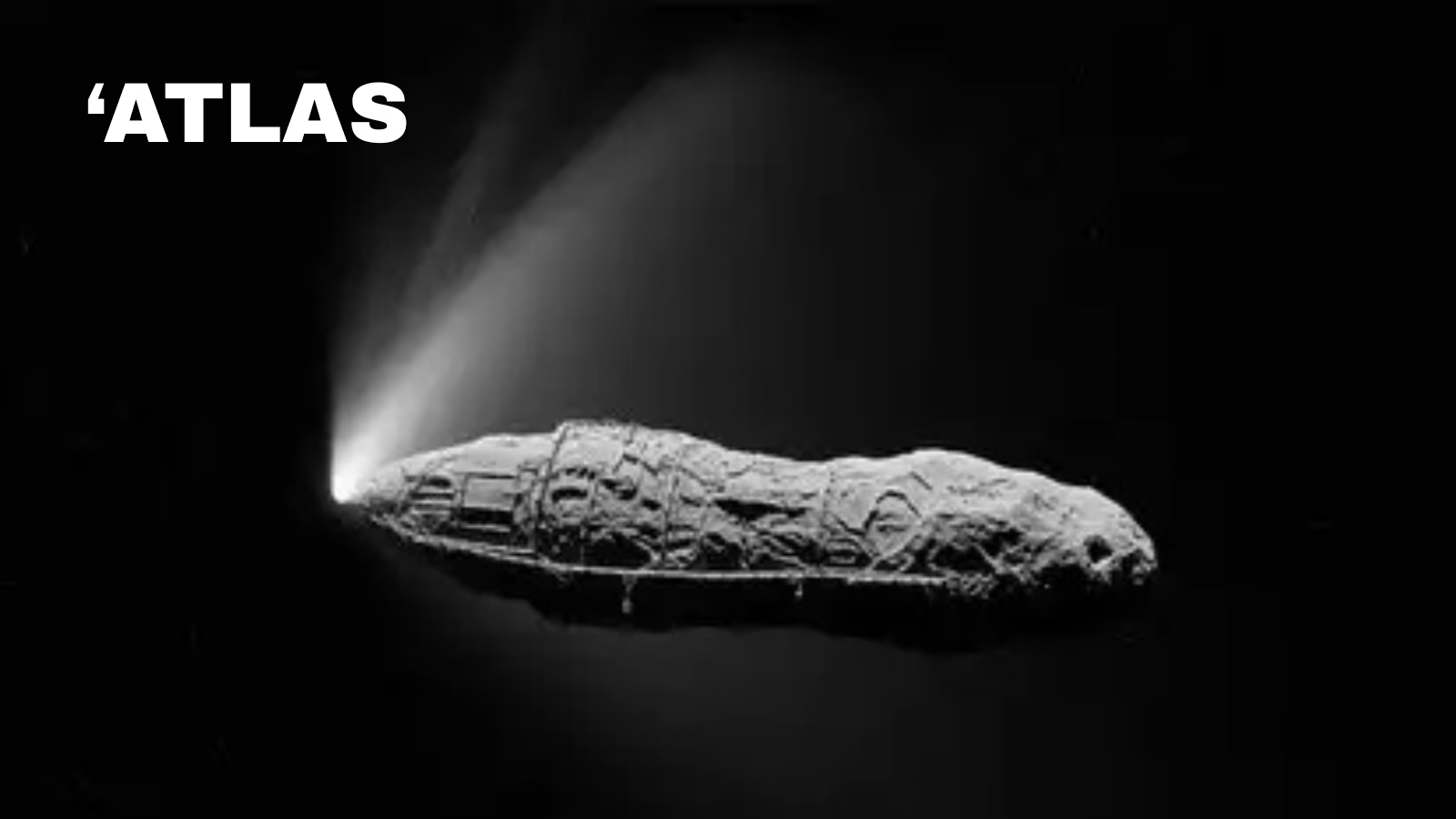
A Fragile Traveler
Atlas fascinated astronomers with its rapid brightening and then its sudden disintegration before reaching the Sun. The comet broke apart into multiple fragments, leaving scientists to piece together clues about its origin.
Its brightness, composition, and fragmentation pattern suggested it might share properties with ʻOumuamua and Borisov, yet its exact interstellar status remains debated. Some models suggest it was part of a larger comet that previously passed through our solar system centuries ago, while others propose it could be an ejected fragment from another stellar nursery.
Why Atlas Matters
Even amid uncertainty, Atlas underscored an important truth: our detection technologies are improving rapidly. Every year, telescopes like Pan-STARRS, ATLAS, and upcoming surveys like the Vera C. Rubin Observatory’s LSST increase our ability to spot faint interstellar travelers. Whether Atlas was truly from another star system or not, it helped sharpen the tools and techniques used to identify such visitors in the future.
My Take
ʻOumuamua, Borisov, and Atlas have collectively reshaped our cosmic perspective. Before 2017, the idea of detecting interstellar objects was purely theoretical. Today, we know that our solar system is not an isolated bubble; it’s part of a dynamic, interconnected galaxy where objects constantly travel between star systems.
These discoveries challenge us to think beyond planetary orbits and cosmic borders. They remind us that space is not a silent void but a living ecosystem of motion and exchange.
As our instruments grow more powerful and our curiosity more daring, it’s only a matter of time before we find the next messenger from the stars. Each discovery brings us closer to understanding how planets form, evolve, and perhaps even how life itself spreads across the galaxy.
The universe is not a collection of distant stars; it’s a conversation. And with every interstellar visitor, we’re finally learning to listen.


0 Comments