
Did you know? A Greenland shark cruising the Arctic right now could be closing in on 400 years old, meaning it may have been alive before the Mughal Empire fell. And it’s not even the strangest animal on this list.
Growing old isn’t optional for most living things. Cells divide, damage piles up, and eventually the whole system gives out. A handful of animals never got that memo. Some just live absurdly long lives without slowing down. One doesn’t age at all, in any sense scientists can measure. And the very last animal on this list has found a way to hit undo on its own life and start over, more than once, apparently forever.
Here’s the countdown of the top 10 immortal animals, saving the weirdest trick for last.
1. Ming the Clam
In 2006, researchers from Bangor University dredged up an ocean quahog clam off Iceland during a sea temperature study. Ocean quahogs add a growth ring to their shells each year, so the rings can reveal their age. The first count made it 405 years old. A more detailed count in 2013 put it at 507 years old, meaning it hatched around 1499, during China’s Ming dynasty.
The catch is that Ming had to be killed to get the accurate age. Scientists cracked open the shell to count the rings, so the oldest confirmed individual animal on record was famous only after it was dead.
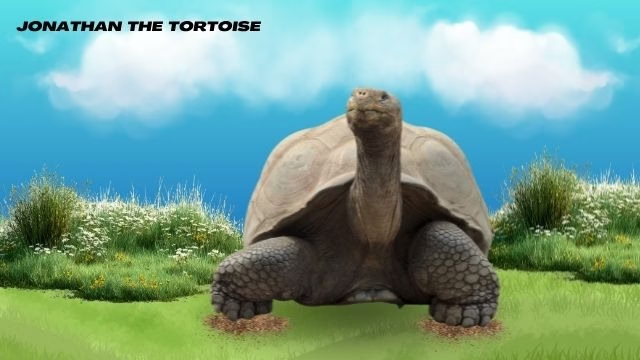
2. Jonathan the Tortoise
Jonathan, a Seychelles giant tortoise on Saint Helena, is still alive and older than most countries. He is estimated to have hatched around 1832, making him roughly 193 years old in 2026 and the oldest known living land animal. He arrived on the island in 1882, already grown.
Jonathan is now blind and has lost his sense of smell, but he can still hear and is hand-fed weekly. A false death report spread online in April 2026. His longevity comes from a long-lived species and a protected environment without predators.
3. The Greenland Shark
Researchers led by Julius Nielsen at the University of Copenhagen studied the eye lenses of 28 female Greenland sharks by radiocarbon dating. The oldest was estimated at 390 years, with a possible range of 272 years to 512 years. That makes the Greenland shark the longest-lived vertebrate known to science.
Its secret is mostly extreme slowness. It grows less than a centimetre per year and may not reach sexual maturity until around 150 years. Its body takes an unusually long time to develop.
4. Antarctic Glass Sponges
Deep in Antarctica’s Ross Sea lives a glass sponge called Anoxycalyx joubini. A two-metre specimen was estimated at 11,000 to 15,000 years old, based on its extremely slow growth. If correct, it was ancient when humans began farming.
Glass sponges build their skeletons from silica and grow less than a centimetre a year in cold, stable water. A related species has been used to study ocean temperatures over 11,000 years. Whether a sponge counts as a single creature like a shark or tortoise is debatable, but its possible age is extraordinary.
5. Naked Mole Rats
Naked mole rats live in East African underground tunnels and are much longer-lived than their size would suggest. They can live for around 30 years, roughly ten times longer than a similarly sized mouse, while showing little age decline. Breeding females can continue producing pups well into old age.
Researchers have recorded very few spontaneous cancers in captive colonies. One reason may be their large supply of hyaluronan, which appears to help prevent tumours. They can survive 18 minutes without oxygen by switching to fructose metabolism. None of this makes them immortal, but it makes them useful for ageing research.
6. Tardigrades
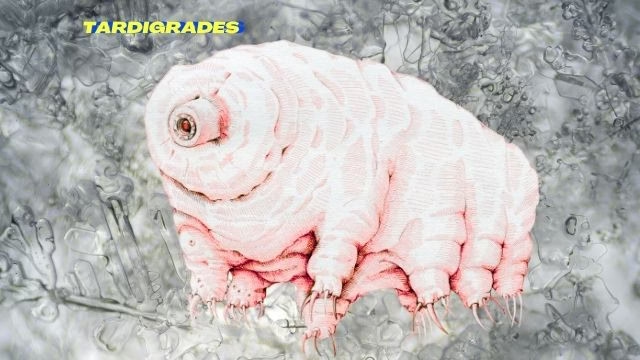
Tardigrades, or water bears, are microscopic animals with short lifespans. Their unusual ability is survival. When conditions turn hostile, a tardigrade can lose up to 97% of its body water, curl into a dry form called a tun and reduce its metabolism almost to zero.
In this state, tardigrades have survived extreme temperatures, extreme pressure, and exposure to space. They use trehalose, a sugar that helps protect their cells while metabolism is shut down. When water returns, they become active again. They are not reversing ageing. They are putting biological activity on hold
7. Planarians flatworms
Planarians are small flatworms with an extraordinary ability to rebuild. Cut one in half, and each piece can grow into a complete worm. Researchers have found that even a piece as small as 1/279th of the original body can regenerate into a whole animal.
The key is stem cells called neoblasts, which make up roughly 30% of the worm’s cells and can form many tissues. In one experiment, a single donor neoblast eventually produced a genetically identical worm. Planarians are not immortal, but they can escape death from severe physical damage
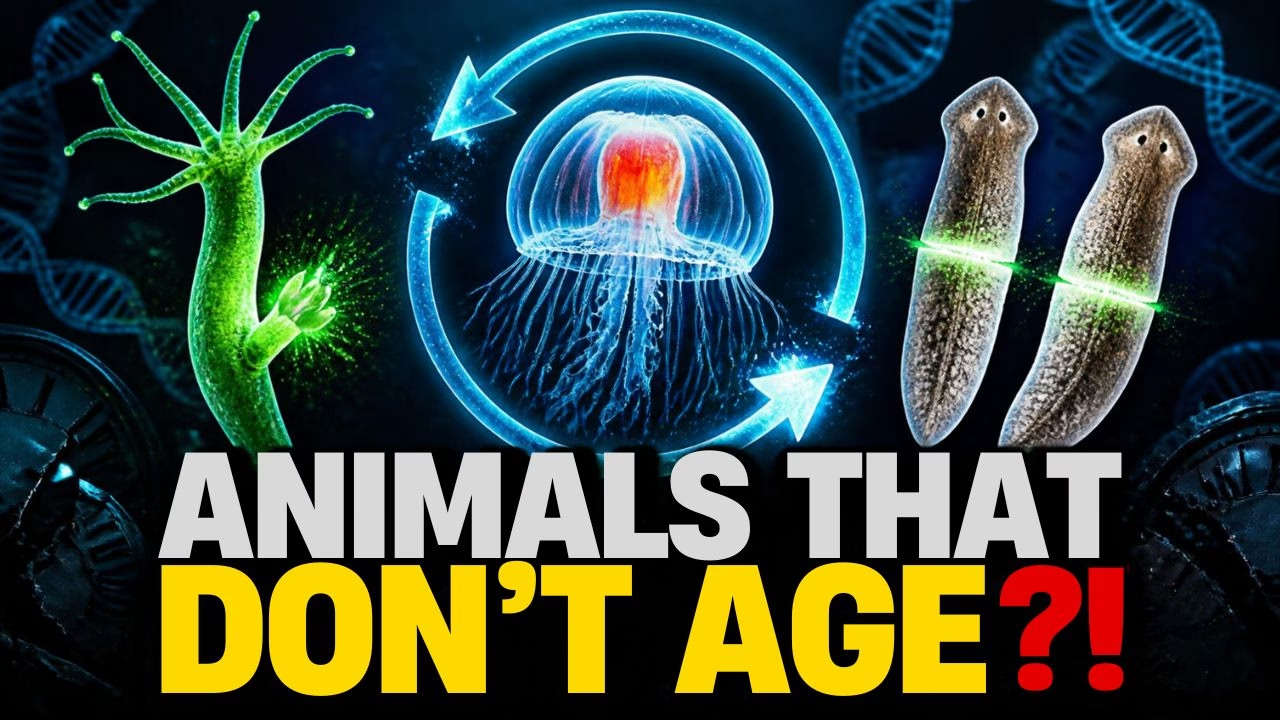
8. Hydra
Hydra are tiny freshwater animals with tentacles and a tubular body. Long-term studies found no clear increase in death rates or decline in fertility. Biologist Daniel Martinez studied them for years, and individual hydras have been kept alive for 12 years without obvious ageing.
About half of a hydra’s cells are stem cells. It continually uses them to replace worn-out tissue, with its body renewed every 20 days. A hydra can still be eaten or killed, but when conditions remain suitable, its biology does not appear to impose a normal expiration date.
9. The Immortal Jellyfish
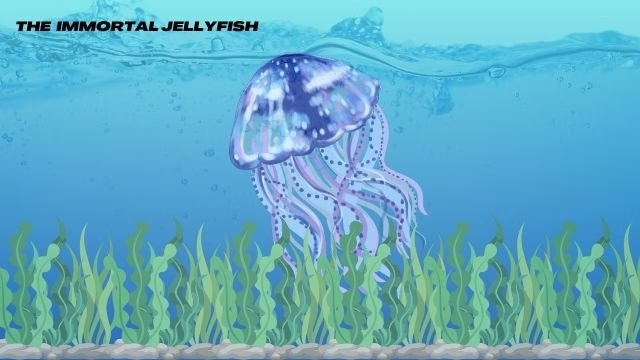
The Immortal Jellyfish Doesn’t Age. It Reverses. Turritopsis dohrnii, called the immortal jellyfish, has a unique ability. When injured, starving or under stress, an adult can transform back into an earlier life stage instead of dying. Its bell contracts, its tentacles are absorbed, and the animal settles as a small mass that re-organises into a polyp.
The process is called trans differentiation. Adult cells change into a flexible state, allowing the animal to rebuild and begin its life cycle again. This cycle can repeat indefinitely. It can still be eaten or killed, so “immortal” means it can potentially escape old age.
Final thoughts
These animals share no single secret to long life. The clam, Greenland shark and glass sponge seem to benefit from living extremely slowly. Others, including hydra, planarians and jellyfish, rely on cellular renewal or regeneration.
The naked mole rat offers another path. Its biology includes mechanisms that appear to limit cancer and protect cells from damage. None of these animals has found a simple way to defeat death. They show that ageing can be slowed, paused, or, in some cases, partly reversed through various biological strategies in nature.
References
- Nielsen, J. et al., “Eye lens radiocarbon reveals centuries of longevity in the Greenland shark,” Science, 2016, via Christian Science Monitor and Gizmodo
- Wikipedia, “Ming (clam)” and “Turritopsis dohrnii”
- Guinness World Records, “Longest-lived sponge species” and Jonathan the tortoise records
- LiveScience, “190-year-old Jonathan is the oldest tortoise ever” and “Hail the Hydra, an animal that may be immortal”
- American Museum of Natural History, “Tough Tardigrades”
- University of Rochester Newscenter, “Why do naked mole rats live long, cancer-free lives?”
- Smithsonian Magazine, “Don’t Listen to the Buzz: Lobsters Aren’t Actually Immortal”
- National Geographic, “An entire flatworm regenerated from a single adult cell”
- iDigBio, March 2021 Biodiversity Spotlight on Turritopsis dohrnii
FAQs
Are there any immortal animals?
Not in the sense of being unkillable. A handful, including the immortal jellyfish and hydra, don’t age in any way scientists can detect, meaning old age alone won’t kill them. Predators, disease, and injury still can. Biologists call this “biological immortality” specifically to separate it from true invincibility.
Are lobsters really immortal?
No, though the myth has a kernel of truth. Lobsters produce an enzyme that keeps repairing their DNA throughout life, so they don’t age the way most animals do. What kills them is usually the physical strain of moulting their shell as they grow, not old age itself.
What's the oldest living animal on Earth?
It depends how you define “animal.” Jonathan the tortoise, at roughly 193, is the oldest known living land animal. An Antarctic glass sponge may be over 11,000 years old, though its simple, brainless structure makes some scientists hesitate to compare it directly to animals like tortoises or sharks.
Can the immortal jellyfish die?
Yes. It can be eaten, get sick, or die from environmental stress before it manages to revert to its polyp stage. Its “immortality” only refers to the fact that it has no biological clock counting down toward old age, not that it’s indestructible.


0 Comments